
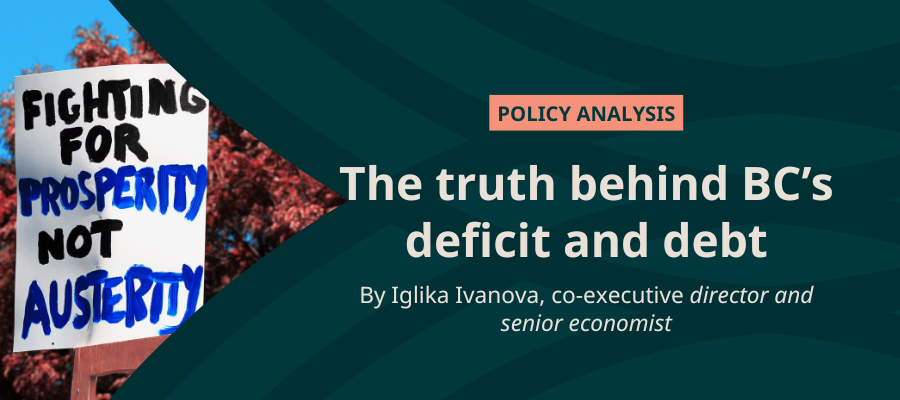
BC has a revenue problem, not a spending problem.
In recent days we’ve heard much about how the provincial government has gone from surpluses to a projected $11.6 billion deficit this year. But before we panic about government spending, let’s examine what really created this fiscal challenge.
The numbers tell a clear story.
Yes, $11.6 billion sounds enormous. But at 2.6% of GDP, this deficit isn’t unprecedented—BC ran slightly larger deficits in 1982 and 1991.
And while BC’s debt has increased sharply in recent years, it remains one of the lowest in the country (as a share of GDP). Even the projected increases over the next few years would leave BC’s debt in the middle of the pack of provinces and lower than Ontario’s today.
“BC’s debt remains one of the lowest in the country.”
As one of Canada’s wealthiest provinces with the third-highest GDP per capita, BC can manage this fiscal challenge—if we address its root causes.
The most telling statistic: BC’s own source revenue—aka taxes, fees and royalties the province has control over—has plummeted from 19.2% of GDP to 15.4% of GDP over the last 25 years. This 3.8 percentage point drop represents $16.8 billion in foregone revenues annually—enough to eliminate the current deficit with money left over for child care, education and other vital investments.
Meanwhile, government spending in 2025/26 is at 21.7% of GDP, slightly lower than the 22.1% of GDP we spent in 1998/99. The recent spending increases under the NDP simply reversed cuts from the previous 16 years. BC is spending the same share of our economy as we did a quarter-century ago but collecting far less revenues.
What caused this?
First, deep tax cuts to personal and corporate taxes in the early 2000s were never fully reversed, eroding BC’s fiscal capacity even as the economy grew.
Second, ending the carbon tax cost us $2.8 billion this year, rising to $3.4 billion in 2027/28. When the BC Liberal government introduced the carbon tax in 2008, it was paired with a new low-income tax credit and substantial personal and corporate tax cuts to make it revenue neutral. Tax rates for the bottom two personal income tax brackets were cut by 5% each, while the corporate tax rate dropped from 12% to 10% (a 17% cut) and the small business rate from 4.5% to 2.5% (a 44% cut).
“BC can manage this fiscal challenge.”
Curiously, when the carbon tax was scrapped in April, the government eliminated only the low-income tax credit but kept the tax cuts, largely benefitting higher earners.
Third, natural resource revenues have declined sharply from 2.5% of GDP in the early 2000s to 0.6% of GDP today—a massive structural shift that must be corrected with higher royalty rates, in particular for non-renewable resources.
Critics calling for more tax cuts ignore a basic fact: BC is already a very low-tax jurisdiction.
We have Canada’s lowest personal income taxes for anyone with taxable income up to $150,000—yes, even lower than Alberta. BC’s sales tax ranks third-lowest among the provinces. Corporate tax rates sit squarely in the middle of provincial comparisons.
Some of BC’s deficit reflects economic headwinds, including impacts from trade tensions. When the economy is weak, tax revenues fall and demand for social services and supports increases, straining government finances. Running deficits in these times makes sense as cutting government spending would only worsen the downturn.
Much of our deficit, however, stems from deliberate policy choices that cut revenues.
The solution isn’t spending cuts.
“BC is already a very low-tax jurisdiction.”
Spending cuts may appear fiscally cautious, but experience from the early 2000s shows that underfunding public services and failing to address poverty leads to higher economic and social costs. Instead, BC needs progressive revenue measures that can fund the public investments our growing population needs while addressing BC’s record inequality.
BC faces record-high income inequality—the richest 20% of households holds 53% of disposable income, the highest in Canada, while the poorest 20% holds only 3%. The growing concentration of income and wealth creates both a moral imperative and an economic opportunity for progressive taxation.
Viable revenue options include: additional personal income tax brackets with higher rates on high-income British Columbians; property tax reform with progressive property tax brackets and a land value tax; corporate income tax increases; and higher natural resource royalties that better reflect the public ownership of resources.
Deficit panic serves a political purpose—it’s used to justify underfunding public services, underpaying public servants and downsizing government. This may benefit the wealthy, but it harms the majority of British Columbians who depend on quality public services.
BC’s fiscal challenge is real but manageable.
To fix provincial finances, we must rebuild the revenue base needed to fund critical investments in affordable housing, public transit, seniors, mental health, child care and decarbonizing our economy. That will make our economy stronger, more resilient and more equitable.
A shorter version of this article appeared in the Vancouver Sun.
