
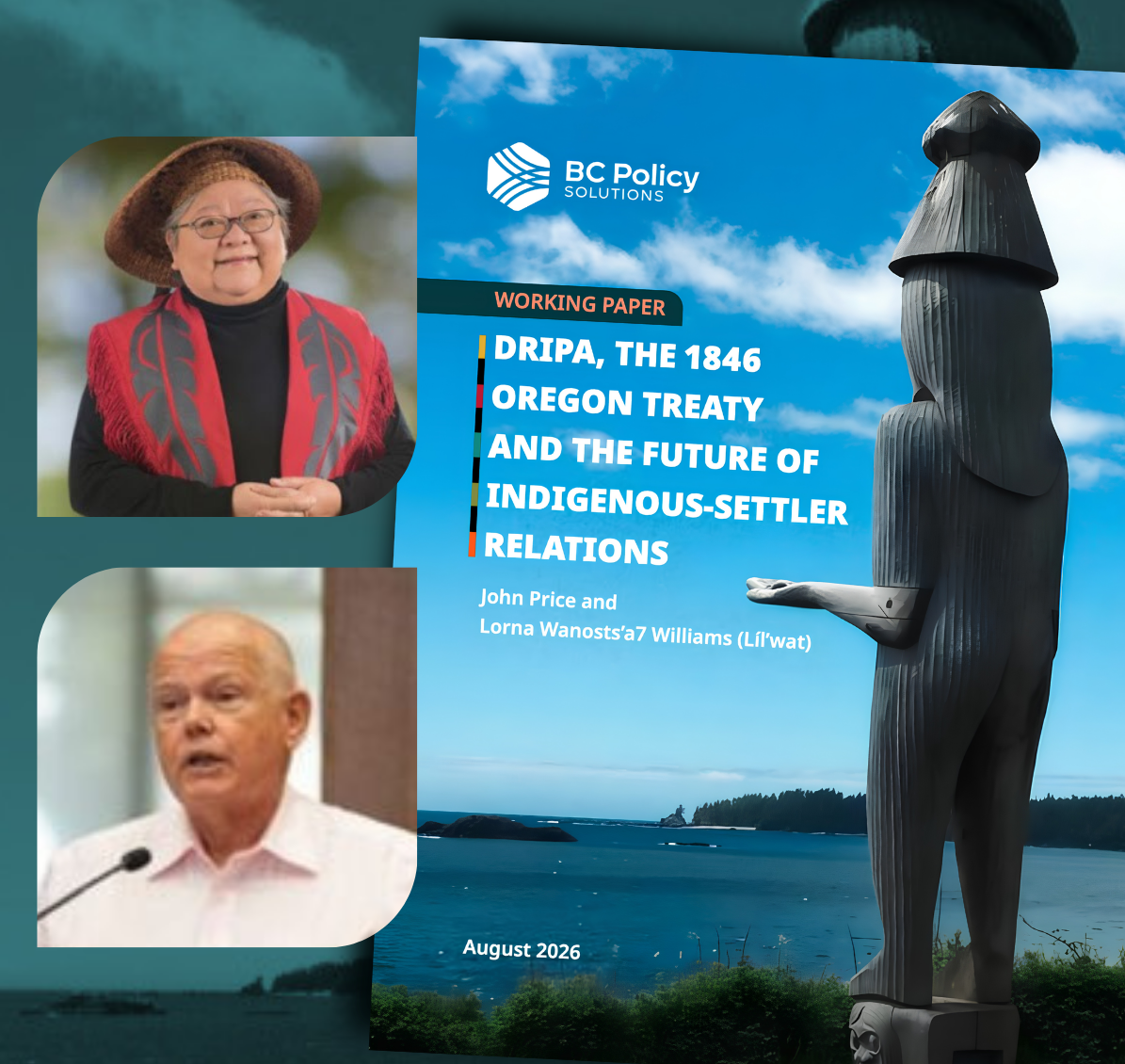

Watch the webinar
Hear from report authors Dr. Lorna Wanosts’a7 Williams and Dr. John Price discuss the colonial backlash to the BC Supreme Court rulings in Cowichan Tribes v. Canada and Gitxaala v. British Columbia.
About this paper
June 15th, 2026 marked the 180th anniversary of the Oregon Treaty, signed in 1846. The treaty is mentioned 143 times in the recent BC Supreme Court ruling in Cowichan Tribes v. Canada and is the basis for the Crown’s claim to sovereignty over the lands we now call British Columbia—yet most settler residents of the province have never heard of this treaty.
In this working paper, Dr. Lorna Wanosts’a7 Williams and Dr. John Price provide an accessible summary of the legal issues, reveal the colonial nature of the 1846 Treaty and outline how a just settlement of land issues will largely depend on fostering stronger Indigenous-settler relations. This publication follows the authors’ recent webinar, Fighting for DRIPA: Countering the colonial backlash to recent Supreme Court Decisions, hosted by BC Policy Solutions in June 2026.
Introduction
In 2019, the British Columbia legislature unanimously passed the Declaration on the Rights of Indigenous Peoples Act (DRIPA) with the intent of bringing BC laws and regulations in line with the United Nations Declaration on the Rights of Indigenous Peoples (UNDRIP).
This was widely celebrated as precedent-setting: BC was the first jurisdiction in Canada to legislate alignment with UNDRIP, two years ahead of the federal government. DRIPA marked an important step toward reconciliation—the ongoing work of repairing the harms of settler-colonialism, including acknowledging the dispossession on which the province was built, restoring Indigenous sovereignty and finding a just way for settlers and First Nations to share these lands.
However, in the wake of two landmark court decisions (Cowichan Tribes v. Canada and Gitxaala v. British Columbia), the BC government announced it would amend or suspend parts of DRIPA. Fierce resistance on the part of First Nations and civil society deterred the government for now, but the province will still appeal the two court decisions. In so doing, they have exacerbated a conservative backlash against Indigenous rights and title, despite First Nations’ repeated commitment to respect private property.
Indigenous people in the province are once again faced with a colonial world intent on taking back changes that First Nations have fought for over generations, as successive governments confined them to reserves, dispossessed them of their lands, and then sold or gave those lands to white settlers, a story told more fully in an earlier publication, Challenging Racist “British Columbia”: 150 Years and Counting.1
In this working paper, we explore the coloniality crisis that has arisen with the recent court decisions and the threat to roll back DRIPA. We contend that this crisis has important ideological and economic dimensions that are rooted in an erroneous colonial concept that the government (Crown) gained sovereignty and title to the lands of this province through the Oregon Treaty, signed 180 years ago, on June 15, 1846. Finally, we suggest that the way forward is by supporting Indigenous title and rights, developing new mechanisms to educate all about Indigenous knowledge and governance, thereby allowing Indigenous-settler relations to thrive and meet the challenges ahead.
To better understand the land and governance issues discussed in this paper, we provide a short glossary:
Crown title: The use of the term “Crown” derives from the crown worn by British monarchs, symbolizing the authority of the state. According to colonial laws, the state assumed “radical or underlying title” to all the lands of the province after it supposedly asserted sovereignty via the 1846 Oregon Treaty.
Aboriginal title: First Nations have always held that they were and remain sovereign over the lands they inhabited from the earliest days. After generations of struggle, the courts finally began to recognize Indigenous rights, and the 1982 Constitution incorporated Aboriginal title as a distinct (sui generis) collective interest in the land, rooted in occupation that predates the Crown’s assertion of sovereignty. The implications and powers associated with Aboriginal title and their relationship to Crown title and fee simple forms of ownership are currently being worked out.
Fee simple: The state (Crown) used its power to allocate lands for settlement through land grants. Ownership of land in fee simple (home ownership on a lot, for example) today remains a form of tenure, a grant from the Crown still subject to the Crown. For example, any minerals on or under fee simple lands remain the property of the Crown; the Crown retains the power to expropriate properties (with compensation); fee simple lands are subject to Crown laws and regulations (including taxation); and fee simple lands that have no legal heirs return to the Crown.
Fee simple is the main form of private ownership recognized in Canadian law. It is most familiar as the way individuals and corporations own homes and lots, but it is not limited to them: governments, including Indigenous governments, can and do hold land in fee simple as well. Those raising the alarm about property rights argue that Aboriginal title threatens fee simple ownership in some way. Presenting Aboriginal title as inherently in conflict with, and a threat to, fee simple ownership is misleading. It idealizes private property while failing to recognize a crucial element upon which fee simple ownership rests: Crown title. Failing to examine fee simple property ownership as it relates to Crown title inappropriately erases the long and particularly harsh history of colonial abuse in this province—the dispossession of lands that rightfully belonged to First Nations, and the hyper-exploitation of natural resources that has created a climate emergency; decimated the forests, waters and lands; and left us under the constant threat of deadly fires, floods and forever pollutants.
Dr. Lorna Wanosts’a7 Williams
A story from Mount Currie
In Mount Currie, when I was living there, I was building a house in the forest. It so happened that it was not that far from the power lines that they were putting through our valley. And when you look at reserves, and what the government has done to reserves. It needs a power line? Go through a reserve. Need a highway? Go through a reserve. You know?
But one of the things that they did at that time, with the power lines, to keep them clear—they sprayed them with a very toxic drug. And that year, many people, if you track their health, many people got thyroid dysfunction. And cancer. That’s the decisions that were made—that, oh, “those natives don’t mean anything, they’re gonna be dead soon.” We have control, they thought; put it through their land.
It’s that kind of thinking that has been really part, an integral part, of government and business. They talk about the economy, but part of the economy has to be:
Care for the land.
Care for the rivers.
Care for the air.
Care for all the vegetation.
The making of a colonial crisis
What we call a colonial crisis began in August 2025, when the BC Supreme Court in Cowichan Tribes v. Canada declared that the Quw’utsun (Cowichan) Nation had title to Tl’uqtinus, a parcel of land on the southern arm of the Fraser River in Richmond. It was a landmark ruling—the first time a court has declared Aboriginal title over land held in fee simple. Before the possible implications of this ruling could even be discussed, the government reacted, immediately declaring it would appeal the ruling: “This ruling could have significant unintended consequences for fee simple private property rights in BC that must be reconsidered by a higher court,” stated attorney-general Niki Sharma.2 The Conservative party and the right-wing Fraser Institute seized on the issue, fanning concerns that the Cowichan decision jeopardized property rights in the province.3
A BC Court of Appeal decision (Gitxaala v. British Columbia) released in December 2025 also extended Indigenous rights. The court ruled that “the Crown has a statutory duty under s. 3 of the Declaration Act to consult and cooperate with the province’s Indigenous peoples in addressing inconsistencies between rights and standards in UNDRIP and the laws of BC. The issue of consistency between the Mineral Tenure Act and UNDRIP is a justiciable question. UNDRIP and the mineral claims regime are inconsistent.” This decision had important repercussions in that it challenged what effectively is a colonial relic—the Mineral Tenure Act, which allowed almost anyone to register a claim to minerals on provincial lands without consulting First Nations. The ruling further clarified that inconsistencies between provincial laws and UNDRIP were “justiciable”—that is, were a matter that the courts could decide. The decision gave teeth to DRIPA and was warmly greeted by First Nations.
Unfortunately, the BC government again decided to appeal this ruling to the Supreme Court of Canada. Premier David Eby then dropped a bombshell when he addressed the BC Chamber of Commerce, stating that he would “go to the wall” to protect private property, that the courts’ rulings were “toxic to work we have to do with First Nations and businesses and the economy that we have to grow,” and that Attorney General Niki Sharma was preparing amendments to DRIPA and the Interpretation Act that accompanies it.4 What had begun as political skirmishes erupted into a full-blown political crisis in the spring of 2026, as First Nations and their allies mobilized to defend Indigenous title and rights.
First Nations argued that the awarding of Indigenous title did not void fee simple (common ownership of land by private entities), and that Indigenous title could and does coexist with private property rights. In response to a recent BC government-Quw’utsun Nation joint statement avowing that neither party is “seeking to invalidate any privately held fee simple titles,” Richmond Mayor Malcolm Brodie stated that the court’s declaration had to be overturned, as “the overall certainty of private property rights for residents must remain paramount.” 5
Over 100 First Nations publicly objected to the BC government’s move to amend DRIPA.6 A joint call for full implementation of DRIPA by West Coast Environmental Law gained wide support from over 130 civil society organizations, including the BC Federation of Labour and the BC Civil Liberties Association.7 They declared: “We are deeply troubled by the recent rise in anti-Indigenous rhetoric and fearmongering in this province that has framed the realization of the fundamental human rights of Indigenous peoples as detrimental to economic growth, security and the interests of others. We stand united in opposition to these divisive narratives.” The Law Society of British Columbia and the BC branch of the Canadian Bar Association added their voices in support of First Nations.
Despite the pushback, the BC government refused to listen. However, faced with cascading support for First Nations, the BC government tried to backtrack, announcing it would not amend DRIPA but would only suspend some of its provisions.8 After opposition from within the NDP caucus surfaced, the BC government retreated, announcing a delay in introducing the DRIPA changes and promising that it would not be a “confidence” vote. Finally, on April 20, the premier admitted defeat, announcing that the government was withdrawing its plans to introduce legislative changes to DRIPA and the Interpretation Act. A joint statement from the premier and the First Nations Leadership Council, composed of the First Nations Summit, the BC Assembly of First Nations and the Union of BC Indian Chiefs, announced that “the government and First Nations Leadership Council are committed to working together with all First Nations leaders on a path forward to discuss and consider the government’s stated legal concerns, while upholding the title and rights and human rights of First Nations.”9 The government’s retreat, the decision to hold talks over the summer, and the end of the spring legislative session have meant an abatement of conflict, but the crisis is far from over.
First Nations have made it clear that their title and rights are not out to dispossess property owners. The landmark Gaayhllxid • Gíhlagalgang “Rising Tide” Haida Title Lands Agreement calls for “a staged transition to Haida jurisdiction, while protecting and maintaining private property rights and existing government services and infrastructure on Haida Gwaii.” The Cowichan Nation has publicly avowed that they were not seeking to invalidate any privately held lands. Furthermore, many legal experts argue that Indigenous title can overlay and coexist with fee simple private property, as does Crown title.10 So what is really at stake?
Political polarization is occurring in many places in the world. In BC, Indigenous title and rights has become the flashpoint, reflecting this province’s unique history. Conservative forces are pushing to roll back hard-won social gains, whether Indigenous rights and title, women’s rights, LGBTQ rights, labour rights or environmental regulations. Kerry-Lynn Findlay, recently elected as leader of the BC Conservative Party, has come under criticism for her anti-Indigenous views and has reiterated the party’s commitment to repeal DRIPA. Her election night clarion call for “family, faith and freedom” eerily echoes the conservative right, south of the border.
However, the current crisis resonates with deep cultural differences that transcend partisan politics. The colonial world conceives of the land as being owned, and ownership translates into economic terms, as monetary—the land is monetized. For the Indigenous world, it’s not about who owns the land, it’s about who is looking after that land and all life upon it. Another layer is economic. The BC government’s agenda focuses on fast-tracking the exploitation of LNG and critical minerals—continuing the long tradition of colonial extractive projects. Some in the government feel that Indigenous title and rights, and the courts’ recent decisions, go too far and that “free, prior and informed consent” may impede the fast-tracking of resource projects.
Governing with a slim majority, the BC government seems to be listening to the Business Council of British Columbia, which recently released a survey in which 98 percent of its members were “very concerned” about DRIPA applying to all laws in the province.11
The threat to the land, regardless of ownership, comes not from Indigenous Peoples but from forest fires, flooding and pollution—an ever-deepening environmental catastrophe that has arisen from unfettered growth. This has often altered the land to the point that it is unable to heal. The crisis that has ensued has revealed a deep cleavage, one that underscores the perpetuation of colonial thinking that has roots in this province’s unique history. First Nations face huge hurdles as they struggle to re-establish relationships, both among themselves and with settler society. The process of healing the land and improving relations between the settler population and Indigenous Peoples will move forward only when settlers better understand the injustices that settler colonialism has caused and the fundamental fault line that underlies the crisis of coloniality.
Dr. Lorna Wanosts’a7 Williams
The Hunter Story
Another set of stories are called nsququqwel’. These stories are about life experiences. When people travelled and returned home, people would gather so that the traveller could tell all that they saw, heard and experienced while travelling. When a Lil’wat hunter returned, the people looked after the animals the hunter brought home and distributed the meat to the families. The hunter would tell about the hunt, how the animals came in a dream directing where the hunter went. The hunter would describe features of the land, such as the creeks and streams and rivers. Did they have debris and deadfall that people needed to clear? What plants were in abundance and where? In what state are the medicine plants? How healthy are all the various animals? The hunter would report seeing other hunters and then describe in detail the relationship with the animals that came to be hunted. That way, the whole community learned about the state of the land and knew what they needed to do to support the land and animals. They also had an opportunity to have a relationship of respect and gratitude with the hunter and the animal that gave itself for the sustenance of the community.12
1846: History matters
The actual fault line in property rights has nothing to do with Indigenous title and rights. The important steps forward in that regard have come through an excruciating legal micro-examination of the history of First Nations stewardship over their lands, providing substantial proof of title. These court decisions have established legal precedents by illustrating that Indigenous title existed prior to the Crown assertion of sovereignty, has never been extinguished, and continues to exist alongside that of Crown title.
Attention is seldom directed, however, at the justification for the Crown’s belief that it asserted sovereignty and thereby acquired “radical or underlying title to all the land in the province.” A judicial consensus has emerged regarding the date that the Crown supposedly gained sovereignty over what would become British Columbia. The consensus points to 1846, when the British signed the Oregon Treaty with the United States. This assertion was based on earlier court rulings, particularly in Calder et al. v. Attorney-General of British Columbia, in which the Supreme Court asserted that the Royal Proclamation of 1763 did not apply to British Columbia.13 In 2014, the Supreme Court of Canada reviewed the lower court’s ruling in the Tsilhqot’in title case and affirmed that in 1846 “the Crown acquired radical or underlying title to all the land in British Columbia at the time of sovereignty.”14 Even in the recent Cowichan decision, Justice Young declared, “I accept this as the date of the British Crown’s assertion of sovereignty and as the date when Aboriginal title arises.”15
So what is the Oregon Treaty? Did it really provide a basis for Crown title?
This year marks the 180th anniversary of the Oregon Treaty, signed on June 15, 1846, between representatives of the British and American governments. Most BC residents have never heard of this treaty. To the degree that it is known as all, it is described as delineating the border between Canada and the United States west of the Rocky Mountains. But the 1846 Treaty was much more than a line on a map: it constituted the colonial justification for the assertion of Crown title—that is, the British, and subsequently BC/Canadian, government control over the lands of the province. Private property rights all derive from and depend on this assertion of sovereignty which, according to the legal decisions to date, derives from the 1846 Oregon Treaty. Given its legal importance and the recent controversies regarding land and title issues, it is incumbent that all peoples on this land understand this treaty.
Prior to 1846, neither the United States nor the United Kingdom asserted sovereignty over what was then known as the Oregon Territory, the lands from Alaska down to California by prior agreement. In the early 1840s, only a few hundred non-Indigenous people lived in the region, compared with an Indigenous population of between 100,000 and 300,000 or more.16 However, imperial contention for control intensified as the Hudson’s Bay Company expanded its operations, turning from furs toward exploiting salmon and forest resources. US corporations and “homesteaders” were also on the move, hoping to take advantage of the region’s resources and access to the Pacific. The election of James Polk as president in 1844 marked an escalation in US expansionism (Manifest Destiny) and a determination to assert US sovereignty over Texas, parts of Mexico and the Oregon Territory. Believing that military action would be necessary to achieve the expansionist agenda into Texas and Mexico, Polk opted for negotiations with the British instead of risking an additional military clash. Both countries appointed senior officials to negotiate a deal on the Oregon Territory in 1845.
After months of negotiations in London and Washington, the US and UK representatives signed the Treaty between Her Majesty and the United States of America for the Settlement of the Oregon Boundary on June 15, 1846, with ratification taking place in London on July 17. The wording of the treaty makes it clear that the purpose was to end the previous ambiguity “respecting the Sovereignty and Government of the Territory on the Northwest Coast of America…” and states that “the territories of Her Britannic Majesty and those of the United States shall be continued westward along the said forty-ninth parallel of north latitude…” The treaty specified that the border would continue into the middle of what is now the Salish Sea and then southward through the middle of Juan de Fuca Strait to the Pacific. Further clauses elaborated on concessions granted to pre-existing corporations, such as the Hudson’s Bay Company. Not a word in the treaty discusses the long-recognized presence of the 100,000–300,000 or more Indigenous people in the area.
Focusing on delineating the division of the Oregon Territory, the treaty wording does not provide any justification for the assertion of sovereignty. Those who care to look, however, can find ample evidence of its rationale by perusing the diplomatic records of the negotiations that took place between the UK and the US in 1845/46. These documents are readily available and reveal the underlying rationale for the assertion of sovereignty. The British case focused on the following points as justification for its assertion of sovereignty:
…in 1778 Captain Cook discovered Cape Flattery, the southern entrance of the Straits of Fuca; Cook must also be considered the discoverer of Nootka Sound, in consequence of the want of authenticity in the alleged previous discovery of that port by Perez.
In 1787, Meares, a British subject, formed the establishment at Nootka, which gave rise to the memorable discussion with the Spanish Government, ending in the recognition by that Power of the right of Great Britain to form settlements in the unoccupied parts of the northwest portion of the American Continent, and in an engagement on the part of Spain to reinstate Meares in the possession from which he had been ejected by the Spanish commander.
In 1792, Vancouver, who had been sent from England to witness the fulfilment of the above-mentioned engagement, and to effect a survey of the north-west coast, departing from Nootka Sound, entered the Straits of Fuca, and after an accurate survey of the coast and inlets on both sides discovered a passage northwards into the Pacific, by which he returned to Nootka, having thus circumnavigated the island that which now bears his name; and here we have, as far as relates to Vancouver’s Island, as complete a case of discovery, exploration, and settlement, as can well be presented, giving to Great Britain, in any arrangement that may be made with regards to the territory in dispute, the strongest possible claim to the exclusive possession of that island.
While Vancouver was prosecuting discovery and exploration by sea, Sir Alexander Mackenzie, a partner in the North-West Company, crossed the Rocky Mountains discovered the head waters of the river since called Fraser’s River, and following for some time the course of that river, effected a passage to the sea, being the first civilized man who traversed the continent of American from sea to sea in these latitudes. On the return of Mackenzie to Canada the North-West Company established trading posts in the country to the westward of the Rocky Mountains.
In 1806 and 1811, respectively, the same company established posts on the TacoutcheTesse and the Columbia.
In the year 1811, Thompson, the astronomer of the North-Wesst Company, discovered the northern head waters of the Columbia, and following its course till joined by the rivers previously discovered by Lewis and Clarke he continued his journey to the Pacific.
From that time until the year 1818, when the arrangement for the joint occupancy of the territory was concluded, the North-West Company continued to extend their operations throughout the Oregon Territory, and to occupy, it may be said, as far as occupation can be effected in regions so inaccessible and destitute of resources.17
The “discoveries,” as articulated in this and other lengthy memoranda, were the only justification provided by the British for asserting sovereignty. To describe the arrival of British explorers as discoveries was the height of imperial arrogance, given that tens of thousands of Indigenous people were already occupying these same lands and without whom the British explorers could not have survived. An accompanying imperial concept was that Europeans were “civilized” and therefore could wilfully ignore the rights of Indigenous Peoples.
These delusions were European ideological and legal constructs derived from what is known as the Doctrine of Discovery. This Christian doctrine originated in a series of Catholic doctrines published by the Pope in the 1400s, which empowered European “explorers” to claim lands they visited on behalf of Christian powers.18 This began with the Pope dividing the world in half, assigning the western hemisphere to the Spanish and the eastern to Portugal. Later imperial powers adopted this same doctrine, or a variation including the “discovery, exploration and settlement” formula found in the 1846 treaty negotiations.
In the negotiations of the Oregon Treaty, no mention is made of the Indigenous Peoples who inhabited the area. Yet buried in the archives of the British Foreign Office is a letter that speaks volumes: “The Oregon Territory, as your Lordship doubtless knows, is occupied by about one hundred and fifty thousand Indians, who inherit it from their ancestors; to whom, therefore, it rightfully belongs, and not in equity to either of the nations claiming the same.”19 Henry Charles Howells, an anti-slavery activist who lived in the US from 1831 to 1842, wrote this letter on May 8, 1845, to the British foreign secretary, the Earl of Aberdeen. Over a year before the treaty was signed, he beseeched “your Lordship, that the British government relinquish their claim to the Oregon Territory in favor of the American Indian…” The British government not only ignored Howells’s request that the land remain under Indigenous stewardship, but also wilfully erased Indigenous Peoples from negotiations and the historical record, rendering the land terra nullius and making it susceptible to the Doctrine of Discovery.
As a result of the long struggle of Indigenous Peoples around the world, the Doctrine of Discovery has been thoroughly repudiated, and thus the Oregon Treaty cannot provide a legal justification for Crown sovereignty or title over the province. Its illegitimacy has been exposed by the United Nations Declaration on the Rights of Indigenous Peoples, adopted in 2007;20 by the Truth and Reconciliation Commission of Canada (2015);21 in the BC and Canadian governments’ acts adopting UNDRIP in 2019 and 2021, respectively; and in the Vatican’s Joint Statement of the Dicasteries for Culture and Education and for Promoting Integral Human Development on the “Doctrine of Discovery” (2023).22
“As a result of the long struggle of Indigenous Peoples around the world, the Doctrine of Discovery has been thoroughly repudiated, and thus the Oregon Treaty cannot provide a legal justification for Crown sovereignty or title over the province.”
In his commentary on the 2014 Tsilhqot’in ruling by the Supreme Court of Canada, Indigenous legal scholar John Borrows asserted that the decision in favour of the Tsilhqot’in Nation represented a major step forward for Indigenous title.23 He noted, however, that “the assertion of radical title retroactively affirms the Crown’s appropriation of Indigenous legal interests without their knowledge or consent. In most other contexts, this would be called stealing. This fraud radically dispossessed each original owner.”24 Borrows’s description applies directly to the 1846 treaty.
The Oregon Treaty provides no justification—legally, historically or morally—for the assertion of Crown sovereignty or title. Its repeated invocation by the government and courts reproduces colonial dispossession in the present. In that sense, an invisible but highly volatile fault line underpins the foundations of the province. This cannot be addressed solely through the legal expansion of Indigenous title; it requires a political solution that addresses the history of the province as a colonial settler state, provides justice for its original title holders and clarifies title and rights issues for those of non-Indigenous heritage.
The future of Indigenous-settler relations
Many complex issues will arise as this province recognizes Indigenous title and rights. How Indigenous title, provincial rights and private property rights might overlap will take time to clarify. One point is certain: attacking Indigenous title or rights or rolling back DRIPA can only end in disaster.
First Nations have proven that they have no intention of confiscating lands that are owned by individuals under fee simple. They will continue to demand, however, that Aboriginal title be recognized and will turn to the courts when necessary. The provincial and federal governments must come to terms with the fact that Aboriginal title is here to stay, accept that DRIPA and UNDRIP cannot be tampered with and move quickly to ensure that all BC laws conform with DRIPA and UNDRIP.
First Nations are not all the same. To survive, some First Nations have bought into massive resource extraction projects. Others are taking a different path. Having lived on these lands for thousands of years, and having survived colonial dispossession and genocide, First Nations hold a vast body of knowledge that they are now rediscovering and are willing to share. But they carry a heavy load. Indigenous education initiatives have made impressive strides over the past 50 years. Language revitalization has been crucial to the cultural resurgence we are seeing today, but it has not been easy.
Many years ago, Douglas & MacIntyre obtained a government contract to publish an Indigenous textbook for school children. Dr. Lorna Wanosts’a7 Williams was one of the writers approached to write a short text. She struggled. The colonial education system had indoctrinated her and others to see themselves as “reserve Indians” and had largely eradicated their native languages, making them feel inherently inferior to whites. Such concepts kept popping up as she tried to put pen to paper. Finally, reflecting in her own language, Líl’wat, she recalled the word “nsnukwnukw7a” and its associated meaning of family, extended family and community. Recalling that word in her language pointed the way forward:
Dr. Lorna Wanosts’a7 Williams
Exploring Mount Currie
And so I wrote the Grade 2 book from the point of view of a family—a little girl, and her brother, and her grandparents, and aunts and uncles, and her relationships with the people in her life, and the land, and the salmon, the rivers, and the lakes, and the trees. This book is just 16 pages, mostly photographs and so I really had to choose carefully the words and the ideas to convey this world to people. Exploring Mount Currie was the title and when it was finally finished, the ministry refused to publish it. A group of educators protested, however, and the book finally came out. That took five years. Institutionalized colonial thinking can really hold things back. And then even when it came out the Vancouver Sun did a two-page spread condemning the booklet under the headline “A rosy-eyed view of an Indian Reserve.”
This institutional bias against Indigenous Peoples, a form of anti-Indigenous racism, continues in many facets of government activity at every level. Language revitalization is poorly resourced, and too often a new sign in an Indigenous language stirs resentment among settlers unable to read the language. This has to change. Indigenous languages deserve the same status as French or English.
In the course of their struggles, First Nations have produced important leaders, including the late George Manuel (Secwepemc, Neskolith). Manuel was an example of how Indigenous people have tried hard to be open, to be generous and to be welcoming. He exemplified how to convey an Indigenous world view and to incorporate it into conversations with others. Over 50 years ago, he articulated an Indigenous perspective regarding land: “This is not the land that can be speculated, bought, sold, mortgaged, claimed by one state, surrendered or counter-claimed by another.” It was the “land from which our culture springs…like the water and the air, one and indivisible. The land is our Mother Earth. The animals who grow on that land are our spiritual brothers.” According to Manuel, the struggle of the past four centuries has been between these two ideas of land.25 We are witnessing that struggle playing out in real time today.
This view of the land is what has inspired First Nations to become leaders in environmental initiatives. Not long after winning their landmark title case in 2014, the Tsilhqot’in First Nation embarked on a major initiative to open the province’s largest solar farm.26 This ongoing project was a pathbreaker, and in its wake another solar project, the Summerland Energy Centre, opened in 2023.27 SFU researchers and others are projecting major benefits through the expansion of such initiatives rather than investing in fossil fuel ventures. The Narwhal, in its Generating Futures series, has also highlighted how Indigenous energy initiatives build culture and community by developing alternative forms of energy, including geothermal sources with the potential for allowing food production in northern climates. These initiatives could be scaled up, too, but unfortunately the province remains committed to massive resource extraction projects rather than a full-scale turn toward renewables.
Idle No More, the Truth and Reconciliation Commission and Every Child Matters are movements that have impacted the consciousness of many people in the province. Issues important to First Nations, however, can be quickly cast aside when other questions come to the fore or when conservative dog-whistling incites anti-Indigenous racism. The ideas that come from the colonial world, like competitiveness and hierarchy, can wreak havoc in discussions or negotiations between settlers and First Nations.
That’s not to say that settlers and Indigenous people can’t work together. They are doing so regularly, and when Indigenous folks are given a leadership role, magic can happen. For example, in the Ministry of Education, when an important policy change had to take place, representatives from a wide range of departments met to determine what needed to happen. Led by an Indigenous consultant, the process was important. The meeting began with introductions, and the consultant introduced the Native way—introducing her relations, her ancestors and their relations with the land. She also talked about how she got her colonial name—derived from the settler who first took her family’s traditional land. Some of the participants were appalled, but others leapt at the chance to come forward, which changed the whole feeling of the room. These introductions took a long time, but when participants began to talk about the policy changes, there was a real commitment from everybody to contribute—they weren’t pitted against each other, or department against department. Working together, people were shocked at how quickly a revised policy could be put together.
Indigenous leadership can really help move things beyond infighting and one department competing against another. People can then work together to come up with solutions. That is the path toward stronger Indigenous-settler relations in the province.

Related content
- Claxton, Nicholas XEMŦOLTW, Fong, Denise, Morrison, Fran, O’Bonsawin, Christine, Omatsu, Maryka, Price, John, & Sandhra, Sharanjit Kaur, Challenging Racist “British Columbia”: 150 Years and Counting, 2021, University of Victoria and Canadian Centre for Policy Alternatives (BC Office).[↩]
- BC Attorney General, “Minister’s statement on the Cowichan Tribes court decisions,” Aug. 11, 2025.[↩]
- See for example, Kirkham, Barry. “All of B.C. now subject to ‘Aboriginal title’ claims,” Aug. 27, 2025, Fraser Institute.[↩]
- As quoted in Charlebois, Brieanna, “Eby promises business leaders to ‘go to the wall’ to protect private property.” National Newswatch, Dec. 10, 2025.[↩]
- BC Ministry of Indigenous Relations and Reconciliation, “Minister and Cowichan (Quw’utsun) Nation Chiefs’ statement on negotiations,” Mar. 2, 2026.[↩]
- Union of BC Indian Chiefs, “Joint statement: B.C.’s Declaration Act provides a backstop of certainty in a world of chaos,” Feb. 9, 2026.[↩]
- West Coast Environmental Law, “Joint call: BC must recommit to meaningful implementation of Indigenous Peoples and the Declaration of the Rights of Indigenous People’s Act,” Feb. 18, 2026.[↩]
- DeRosa, Katie, “NDP government to pause DRIPA amendments amid caucus divisions,” CBC News British Columbia, Apr. 13, 2026.[↩]
- BC Office of the Premier, “Premier’s, First Nations Leadership Council statement about DRIPA,” Apr. 20, 2026.[↩]
- Gunn, Kate, “Correcting misconceptions: Aboriginal title, private property and the Cowichan Tribes decision.” First People’s Law Blog, Oct. 27, 2025.[↩]
- Business Council of British Columbia, “BCBC survey: DRIPA leading to significant business concerns,” Media release, May 6, 2026.[↩]
- Lorna Williams, “Ti wa7 szwatenem. What We Know: Indigenous Knowledge and Learning,” BC Studies 200 (Winter 2018/19), 34–35.[↩]
- “The British Columbia Courts have dealt with the history of the discovery and settlement of their province. The history demonstrates that the Nass Valley, and, indeed, the whole of the province could not possibly be within the terms of the [Royal] Proclamation [of 1763].” Calder et al. v. Attorney-General of British Columbia, [1973] SCR 313. 325.[↩]
- Tsilhqot’in Nation v. British Columbia [2014] 2 SCR 256, (71). This ruling did not provide a historical overview of Aboriginal title and relied on the Guerin decision in its description of Aboriginal title. It accepted that sovereignty over British Columbia was asserted in 1846 with the Oregon Treaty. See s. 60.[↩]
- Cowichan Tribes v. Canada (Attorney General) [2025] SCBC 1490, [535].[↩]
- The lower figure is based on estimates contained in Wilson Duff, The Indian History of British Columbia, vol. 1, The Impact of the White Man (Provincial Museum of Natural History and Anthropology, 1969), 38–39; and Matthew McCarthy, “Native American Population Decline during the Nineteenth Century,” 2014, available at https://nativestudy.wordpress.com (viewed 16 April, 2026). The higher figures are based on Indigenous oral history.[↩]
- Mr. Pakenham to Mr. Buchanan (Inclosure 2 in No. 28), Washington, July 29, 1845, in British Parliamentary Papers: Canadian Boundary, Vol. 2 (Irish University Press, 1969), 43–44.[↩]
- For a historical overview, see Robert J. Miller et al., eds., Discovering Indigenous Lands: The Doctrine of Discovery in the English Colonies (Oxford University Press, 2010), and Jennifer Reid, “The Doctrine of Discovery and Canadian Law,” Canadian Journal of Native Studies 30, no. 2 (2010), 335–359. The most thorough analysis and understanding of the issues can be found in Kent McNeil, “The Doctrine of Discovery Reconsidered: Reflecting on Discovering Indigenous Lands: The Doctrine of Discovery in the English Colonies, by Robert J Miller, Jacinta Ruru, Larissa Behrendt, and Tracey Lindberg, and Reconciling Sovereignties: Aboriginal Nations and Canada, by Felix Hoehn,” Osgoode Hall Law Journal 53, no. 2 (2016): 699–728.[↩]
- Howells to Aberdeen, 8 May, 1845 (Series GR-0327, Foreign Office Transcripts, F.O. 5, Vols. 401–444, 1843–1845, BC Archives), 177.[↩]
- The United Nations Declaration on the Rights of Indigenous Peoples, adopted in 2007, declares that “Indigenous peoples have the right to the lands, territories and resources which they have traditionally owned, occupied or otherwise used or acquired” (Article 26.1), governments should establish with Indigenous peoples a “fair, independent, impartial, open and transparent process” to resolve land issues (Article 27), and “Indigenous peoples have the right to redress, by means that can include restitution or, when this is not possible, just, fair and equitable compensation, for the lands, territories and resources which they have traditionally owned or otherwise occupied or used, and which have been confiscated, taken, occupied, used or damaged without their free, prior and informed consent” (Article 28.1). United Nations, United Nations Declaration on the Rights of Indigenous Peoples, United Nations, 2007, 10.[↩]
- Truth and Reconciliation Commission of Canada, Truth and Reconciliation Commission of Canada: Calls to Action, Truth and Reconciliation Commission of Canada, 2015, 4–5.[↩]
- Holy See, “Joint statement of the Dicasteries of Culture and Education and for Promoting Integral Human Development on the “Doctrine of Discovery,” Mar. 20, 2023), Vatican Press Office. [↩]
- John Borrows, “The Durability of Terra Nullius Tsilhqot’in Nation v. British Columbia,” UBC Law Review 48, no. 3 (2015), 701–742.[↩]
- Borrows, “The Durability of Terra Nullius Tsilhqot’in Nation v. British Columbia,” 724.[↩]
- George Manuel and Michael Posluns, The Fourth World: An Indian Reality (University of Minnesota Press, 2019; first published 1974 by the Free Press), 6.[↩]
- Lavoie, Judith, “Tsilhqot’in First Nation opens B.C.’s largest solar farm,” The Narwal, Nov. 4, 2019.[↩]
- See the Summerland Energy Centre’s page on the District of Summerland’s website: https://www.summerland.ca/your-city-hall/climate-action/solar-and-battery-facility.[↩]

You must be logged in to post a comment.