
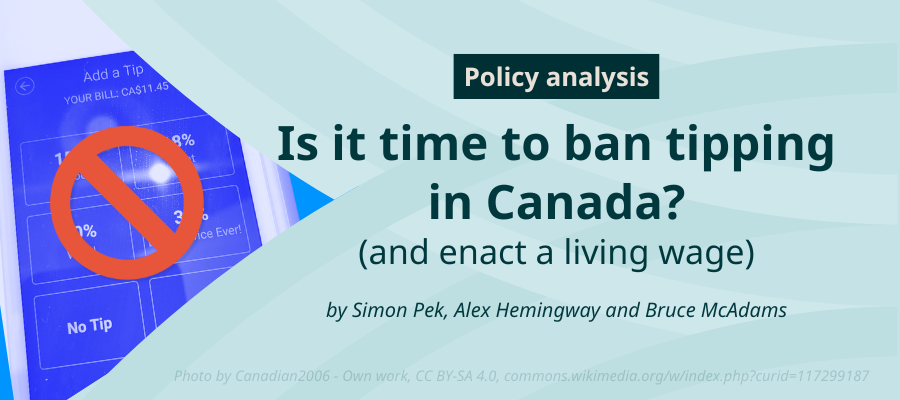
Is it time to end tipping in Canada?
The landscape of tipping in Canada has changed dramatically in recent years. With ‘tip creep’, a growing number and range of businesses prompting customers for tips, while ‘tipflation’ means suggested tips keep rising.
As many workers struggle to get by amid a cost-of-living crisis, these trends help boost workers’ overall take-home pay when compared to a minimum wage floor.
The story doesn’t end there, however.
Tipping and tipflation signal a growing and consequential shift in responsibility for workers’ pay from employers to customers, with significant downstream consequences like income volatility and workplace inequity.
An increased understanding of tipping’s negative effects, combined with rapidly changing public sentiments, suggest that the spread of tipping isn’t the best way of helping workers make ends meet.
Against this backdrop, Canadians should consider a bold alternative to using tips to boost workers’ pay: banning tipping and replacing it with a living-wage floor, ensuring decent wages for all workers and transparent pricing for customers.
The shifting landscape of tipping in Canada
Where tipping was once common in a small number of industries like full-service restaurants, customers are now seeing tip prompts at their local coffee shop or, increasingly in coffee chains like Starbucks, as well as a growing number of fast-food or fast-casual restaurants like Subway.
Customers report prompts in a host of other contexts, including u-pick farms, graduation dress pickups and retail liquor stores. Fifteen per cent used to be the default for good service in a restaurant, but many prompts now start at 18 per cent and can reach 30 per cent.
Recent surveys find Canadians are not only experiencing tip creep and tipflation, but increasingly are looking for alternatives. A 2023 Angus Reid survey found a marked shift in public sentiment towards workers’ compensation models since 2016, with 59 per cent preferring a model with higher wages and service included compared to 32 per cent preferring a tipping model. In a more recent H&R Block survey by, 91 per cent of participants favoured a shift away from tipping toward employers paying their employees’ better wages.
Yet customers’ growing discomfort is only part of the story.
While tipping boosts workers’ overall pay when compared to a minimum wage floor, a growing body of research highlights its negative aspects. Customers’ ultimate control over whether or how much to tip means that workers’ incomes become more unpredictable and can vary based on characteristics unrelated to the quality of their work like their racialized status or attractiveness. Some customers even use their position of relative power to engage in inappropriate or disrespectful behaviour that workers find difficult to avoid.
Tipping can also create friction among workers, including competition among staff who receive tips for more lucrative opportunities and conflict between front- and back-of-house workers over relative compensation. More broadly, the spread of tipping may portend a fundamental shift in who is ultimately responsible for workers’ welfare from employers to customers, risking further erosion of working conditions.
Surprisingly, policymakers have paid limited attention to these trends and shifting attitudes, despite governments’ longstanding role regulating tipping through employment standards legislation. A notable exception is Quebec’s Bill 72, which mandates that tip percentages be applied on pre-tax bills and places restrictions on how tip prompts can be presented. While Quebec’s effort may curb tipflation to some extent, it leaves tip creep and the effects of tipping on workers unaddressed.
From tipping to a living wage?
Given these issues and shifts in public attitude, now is the time for Canadians to contemplate a bolder step: banning tipping and raising minimum wages to at least the level of the local living wage. Living wages aim to ensure that workers earn enough to have a reasonable standard of living based on local costs.
Echoing legislative efforts in several U.S. states in the early 20th century, tipping could be banned in several ways, such as barring businesses from encouraging or collecting tips, whether through tip jars or payment platforms. Workers’ wages would be fully paid by employers, who could in turn incorporate higher wages into prices or clearly disclosed surcharges that could be adjusted periodically.
To preserve one benefit that some associate with tipping—a sense of control over performance-linked rewards—businesses could pair living wages with greater job autonomy and clear, well-designed bonus systems based on customer or stakeholder feedback.
Several Canadian businesses have actually adopted variants of this model over the years, even in industries where tipping is the norm.
These include Waterloo-based TWB Brewing and Odd Duck Wine & Provisions, Toronto-based Barque Smokehouse and Vancouver’s Cowdog Coffee and Folke restaurant.
While no compensation model is perfect, this living wage model may be preferable to what appears to be the prevailing alternative taking shape in Canada: businesses opting to keep wages and wage increases lower because they can ask customers to subsidize them through tips.
“It’s time for Canadians to contemplate a bolder step: banning tipping and raising minimum wages.”
A shift to the living wage model aligns with changing public sentiment calling for an end to tipping and a shift to higher wages for workers. It reduces income volatility, vulnerability to customers and conflict among workers. Perhaps most fundamentally, it moves our society back in a direction where the onus is on employers to pay decent, livable wages rather than asking customers to fill the gaps created by low wages.
Some may raise concerns about the practicality of this model.
Legislative efforts to ban tipping in the United States were all eventually repealed for reasons including employer resistance and the fact that many customers continued to tip and workers continued to solicit tips. Tipping can become a powerful social norm. Once some people begin tipping in a given context, whether as a way of boosting their status or securing better service in the future, others increasingly feel the pressure to follow suit.
These norms, however, do not develop in a vacuum.
Businesses can influence whether to allow and encourage tipping. With the rapid spread of payment by credit and debit cards—the Bank of Canada found that only a fifth of payments were made with cash in 2023—it is easier to ban tipping now because the vast majority of transactions take place through payment portals that don’t return change to customers. Customers may be less interested in tipping if they are aware that workers’ baseline pay is a living wage. To be sure, some customers may be tempted to offer tips when paying with cash so public education and notices of the new policy will be needed.
Another concern is potential hardship for businesses and highly paid tipped workers, like some servers in high-end restaurants.
“Customers may be less interested in tipping if they are aware that workers’ baseline pay is a living wage.”
While many businesses have been trying to shift away from tipping over the decades, going it alone is challenging. Customers often balk at higher prices and highly paid front-of-house staff may be tempted to seek work with competitors where they can collect tips. Many businesses that try to end tipping practices end up reverting, such as Toronto’s Beast Pizza and Parksville’s now-closed Smoke ‘n Water.
However, a universal living wage model would create an even-playing field, making it easier for businesses to increase prices and pay a living wage, while customers would no longer have to tip. Additionally, there are potential benefits for businesses, including reduced compliance costs and risks tied to managing tipping regimes and an ability to focus on consistent service for all customers.
Under a living wage model, many low wage workers would benefit from higher pay and more stability, though some workers who receive high tipps may see at least a modest reduction in overall pay. Some wage compression between currently tipped and non-tipped workers is likely inevitable, but a living wage model would help reduce inequality among workers. Transparent, well-designed bonus systems could help workers increase their pay.
Furthermore, the living wage model would give workers several additional benefits like reducing some of the tensions and rivalries among workers that often accompany tipping. Raising the wage floor to a living wage could help increase workers’ bargaining power, while giving businesses an incentive to support public policies (e.g., in areas like housing and child care) that reduce living costs for workers and, thereby, reduce upward pressure on the living wage levels they must pay.
“A universal living wage model would create an even-playing field.”
A final concern relates to customer choice.
While a majority of Canadians appear to want to ditch tipping, a minority prefer the status quo and may feel that a ban on tipping encroaches on their freedoms. But the pressures of tip creep and tipflation mean that the majority can’t shift tipping culture through individual action, necessitating broader public policy intervention. Furthermore, when push comes to shove, the overall benefits accruing from shifting away from tipping to living wages may be more important than preserving the option to tip.
As Canadian workers grapple with a cost-of-living crisis, tipping is increasingly being used as a way of topping up workers’ pay. An ever-expanding tipping culture with all its side effects is not inevitable, however.
Policy action to ban tipping and enact a living wage could help short-circuit these trends and contribute to a fairer economy. To navigate the complexities of such a transition, stakeholder consultations like a Fair Wages Commission could be convened to define the implementation strategy, ensuring the perspectives of workers, businesses and customers are represented.
Tip creep and tipflation have galvanized public opposition and this may be the moment to move towards transparent pricing for customers and a more worker-centred compensation model.
A condensed version of this article was published in The Tyee.


