
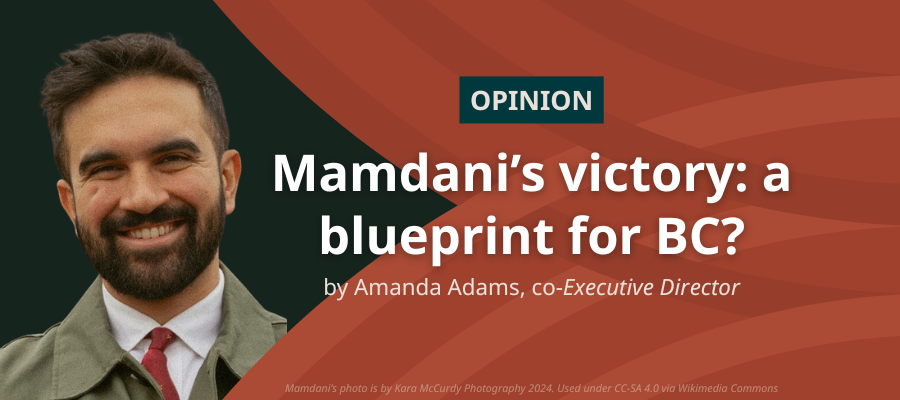
Earlier this year, our racial equity researcher Véronique Sioufi wrote a timely piece asking: ”Could Mamdani’s bold agenda work in BC?” At the time, Zohran Mamdani was an underdog in New York City’s mayoral race. He is now New York’s next mayor.
The contest drove the biggest turnout in a mayoral race in more than 50 years with more than two million New Yorkers casting ballots, according to the city’s Board of Elections. Some see his popularity with voters as a signal that people are ready for bold, progressive policies centred on affordability.
What made his campaign different
Before diving into policy, it’s worth briefly exploring how Mamdani won because the development and delivery of his platform was as important as the platform itself.
“We won because New Yorkers allowed themselves to hope that the impossible could be made possible,” Mamdani said in his victory speech “and we won because we insisted that no longer would politics be something that is done to us. Now, it is something that we do.”
His optimism, combined with messages of hope and forward-looking solutions, cut through political disinterest and cynicism. With clear, consistent messaging centred around hope and democracy over oligarchy, Mamdani’s policies spoke to voters and didn’t speak down to them. He particularly connected with those under 30, based on voter turnout.
It’s clear that New York voters were eager for a new politics.
Mamdani noted in his speech that he was not one to follow conventional political wisdom.
“The conventional wisdom would tell you that I am far from the perfect candidate,” he said. “I am young, despite my best efforts to grow older. I am Muslim. I am a Democratic socialist. And most damning of all, I refuse to apologize for any of this.”
Mamdani offered bold, concrete policies on everyday issues like rent and child care costs. His platform was accessible. He maximized use of digital and viral content that was personal, engaging and informative in a way we haven’t seen in a political campaign.
He was a candidate brave enough not only to name issues, but to offer tangible, long-term solutions.
The winning issue: affordability
Mamdani’s campaign was laser-focused on affordability: it was synonymous with his campaign from start to finish. This wasn’t an accident, but the result of listening to voters.
BC faces similar issues: increasing housing costs, wages not keeping up with inflation and over-stretched public services. New York City’s recent election is demonstrative of what can happen when proposed policy addresses kitchen-table issues head-on, instead of offering incremental tweaks.
“New York City’s recent election is demonstrative of what can happen when proposed policy addresses kitchen-table issues head-on, instead of offering incremental tweaks.”
In her August analysis, Véronique examined Mamdani’s platform and found striking parallels with the evidence-based policies for affordability that we have long advocated for in BC. Let’s look at the key areas:
Housing as a human right
Mamdani’s plan for 200,000 permanently affordable homes through public investment is recognition that the public sector must lead the way in addressing the housing crisis. This is also true in BC. We’ve called for at least 25,000 publicly funded non-market homes annually, including non-profit, co-op and social housing.
Mamdani and his allies have also called for an end to exclusionary zoning policies, especially in wealthy neighbourhoods that have historically blocked housing, to “allow housing supply” to meet New York’s need for homes. This closely mirrors our researchers’ calls for ending apartment bans in cities like Vancouver and analysis showing why a chronic shortage of housing supply in BC hurts renters and vulnerable people most.
The principle is the same: housing is a human right.
Affordability through public and community services
Mamdani’s campaign promises (like free child care and free transit) signal that he understands that affordability requires not just raising wages but also reducing the cost of living essentials. We’ve long advocated for a higher minimum wage, $10-a-day child care, and we’ve explored how free public transit in BC would improve equity while cutting household costs.
Mamdani also addressed the root causes of crime and harm in communities: inequity and a lack of housing, healthcare and income supports. It’s a strategy we also advocate for in BC that supports longer-term growth and buffers against future crises.
Public services aren’t luxuries. They’re investments to make wages go further for working families.
Progressive taxation to fund the vision
The first question that always emerges: How do we pay for all of this?
Unsurprisingly, this question is repeatedly asked about funding Mamdani’s agenda. And it’s one we regularly hear when making the case for stronger public services in BC. In both cases, tax increases on the top 1% and corporate profits can fund essential investments for the majority. Investing in public services and addressing the conditions that lead to inequity isn’t only morally correct, it’s smart, long-term economic policy.
BC has the fiscal capacity to pursue a vision similar to Mamdani’s. Raising the revenues we need is a question of political will, not economic feasibility.
Many claim that programs like Mamdani’s are unrealistic. Yet, his vision for a more affordable city, articulated through savvy social media and upbeat interactions, resonated with voters. We research and advocate for similar policies here in BC. In her August article, Véronique asked, ”Can these policies actually be implemented?” Her answer was a resounding yes.
It is not whether such an agenda could work in BC, but whether we dare to turn such ideas into policy.
Mamdani’s win shows that voters are hungry for his kind of politics. People want leaders who will tackle affordability head-on, not tiptoe around the edges.
The blueprint is available and our research supports it. Are we ready to demand more from our political leaders?
