British Columbia’s public post-secondary education system is facing its worst funding crisis in history.
Nineteen of the province’s 25 public institutions are projected to operate at a loss with an estimated $300 million annual shortfall.
Since 2024, post-secondary institutions have cut or suspended over 180 programs, laid off more than 1,300 faculty and countless contract staff and closed over 45 student services. BC’s public colleges and teaching universities have been hardest hit.
What does this crisis look like for staff and students?
In our report (Rebuilding post-secondary education as public infrastructure in BC), President of the Vancouver Community College Faculty Association Frank Cosco estimates the institution lost at least 100 contract staff and sessional instructors through the termination or non-renewal of contracts. That’s on top of an additional 150 officially announced layoffs.
There have also been 14 program cuts or suspensions and three service cuts at VCC.
“It’s an absolute failure of public funding of post-secondary in BC.”
Frank Cosco, Vancouver Community College Faculty Association President
“It’s just been devastating,” Cosco said, during a BC Policy Solutions webinar on the post-secondary funding crisis, “we have people without sustainable family incomes anymore who did nothing wrong but try to educate and train folks.”
President of the Vancouver Community College Faculty Association, Frank Cosco, explains what the post-secondary funding crisis looks like for VCC.
The commodification of international students as a band-aid to chronic government underfunding
The fact that the Canadian post-secondary sector so easily became dependent on international student tuition to make up for historic government underfunding is rooted in colonialism. Institutions are built on unceded Indigenous territories and still rely on assumptions of Western superiority and economic dependencies between the Global North and South to attract students.
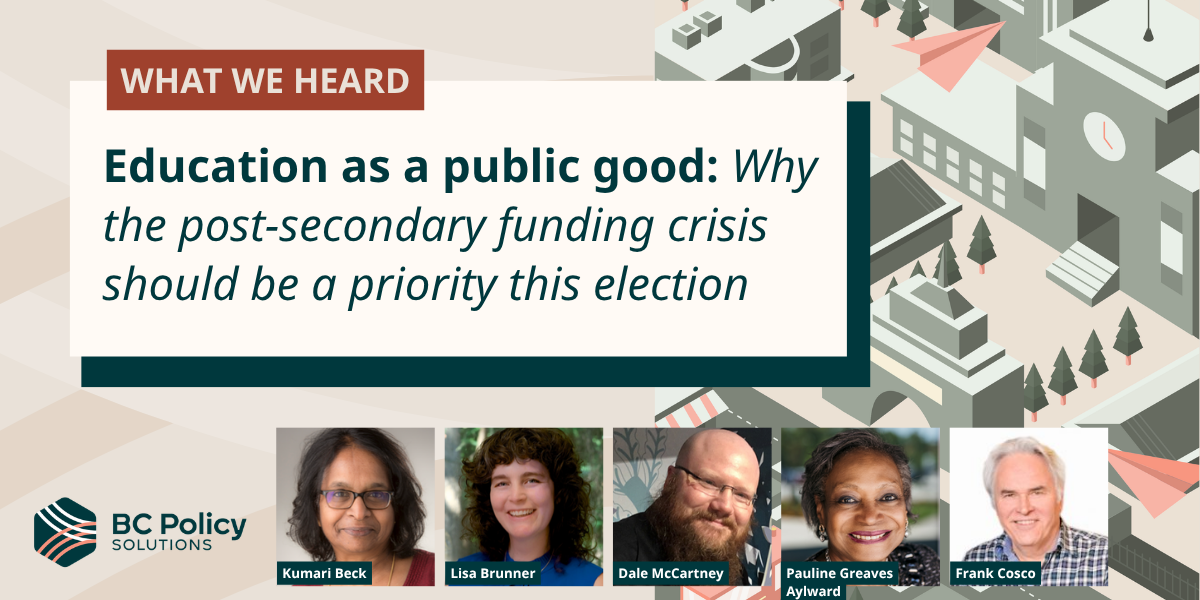
As post-secondary scholars Dale McCartney and Lisa Brunner explained in our webinar, this model has essentially become a market-driven, extractive system that means Canada’s post-secondary education sector has become dependent on large-scale wealth transfers from the Global South to the Global North.
This system was pushed to a tipping point in 2024 with a change in federal immigration policy.
Immigration, Refugees and Citizenship Canada (IRCC) announced the first-ever cap on international student permits starting in January 2024, intending to cut new approvals by 35% from 2023 levels and a further 10% in 2025.
The policy was justified as a “stabilization” measure, arguing that rapid population growth was straining Canadian infrastructure such as housing and healthcare. That framing has been disputed by scholars who argue these issues have been decades in the making, and that the new immigration policy unfairly scapegoats racialized students and migrants.
Kumari Beck, co-director of the Centre for Research on International Education at SFU, described the worst of changing attitudes as starting during the COVID-19 pandemic when there was “licence for people to engage in heinously racist practices against international students.”
“These are people who have taken the brunt of everything that has gone on in this generation of raising revenue,”
Kumari Beck, co-director of the Centre for Research on International Education at SFU
The way forward: Education as a public good
As provincial and federal governments have retreated from investing in public goods and services in favour of industry, BC will head to the polls for municipal and provincial elections in October. Meanwhile, the institutions that help create an informed electorate and a productive society have been gutted financially.
Additionally, the BC Tuition Limit Policy that caps domestic tuition increases at 2% annually is under threat. If removed, the province would be exacerbating the growing gap in access to education between wealthy families and those from lower-income families, Indigenous students and students in rural areas where there are no alternative institutions.
“We’re treating education like a private investment,” BC Policy Solutions researcher and report author Véronique Sioufi said during the webinar.
Sioufi said that while graduates do benefit personally from having access to quality post-secondary programs, an educated population also drives innovation, grows the tax base, supports public health and sustains a democratic society.
“Post-secondary passes the economic textbook test of a public good like roads, bridges, hospitals and clean drinking water.”
Véronique Sioufi, BC Policy Solutions Senior Racial Equity Researcher and Policy Analyst
Sioufi said this means fully funding post-secondary isn’t a subsidy to individual students but rather an essential investment in our shared infrastructure.
This provincial election, is funding for public post-secondary education a key issue for you? Let us know via Bluesky, Instagram, LinkedIn or Facebook.
BC Policy Solutions Senior Racial Equity Researcher and Policy Analyst Véronique Sioufi explains why education should be looked at as a public good.
This article was based on the September 17, 2026 webinar BC Post-Secondary Education in Crisis: How we got here and how we get out. Watch the recording and read the full report here. And please share to make funding public PSE an issue that can’t be ignored.