
NOTE: A shorter version of this article ran in the Vancouver Sun.
As municipal and provincial elections approach, BC’s biggest, most expensive cities should face scrutiny for their role in the ongoing housing crisis.
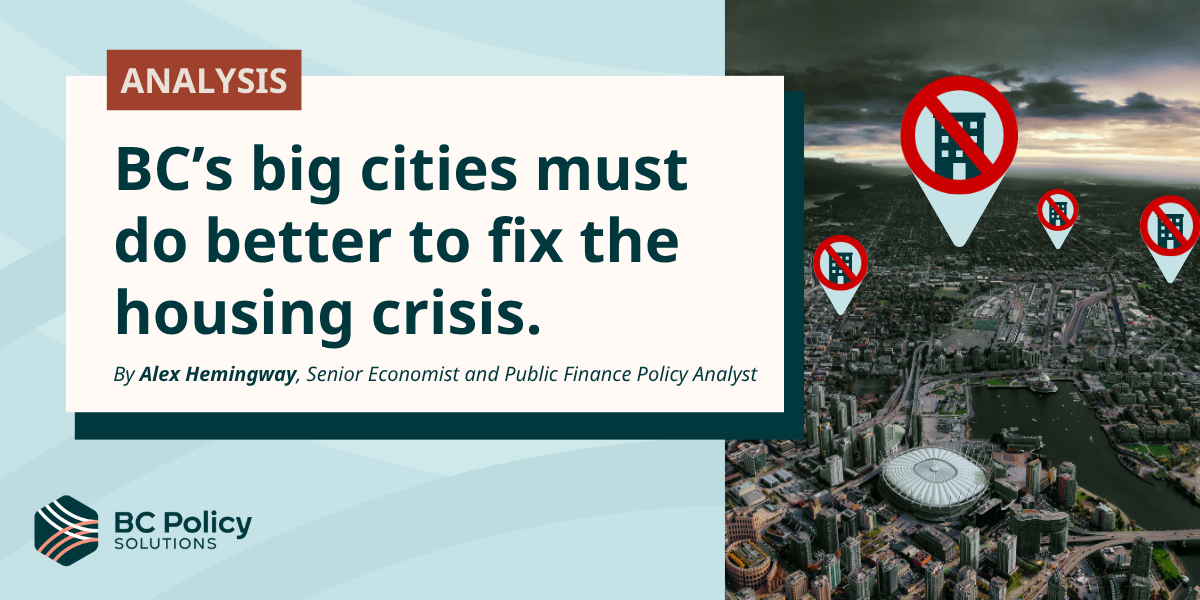
We have a severe shortage of homes, yet cities like Vancouver continue to block apartments across most residential areas, suppressing new housing and driving up the cost of market and non-market homes alike. Cities have the power to make room for more homes people can afford in neighbourhoods where they want to live.
Recent improvements in vacancy rates and rents are welcome, but neither these gains nor a few thousand slow-to-sell condos mean our housing shortage has disappeared.
The housing shortage is reflected in high prices and rents, but also in people forced to live with parents, roommates or even ex-partners because they cannot afford to form an independent household. Researchers have estimated there are 130,000 to 200,000 of these “suppressed households” in Metro Vancouver alone.
Cities decide where housing is allowed, how much can be built on a lot, whether land assemblies are required, what fees are imposed and whether projects face years of costly discretionary approvals.
That is enormous unmet demand for more homes from existing residents, before even counting people already priced out of the region. When cities like Vancouver exclude people by blocking apartments on most of their land, they push people into other communities, effectively exporting their housing crises around the province and creating sprawl.
Cities decide where housing is allowed, how much can be built on a lot, whether land assemblies are required, what fees are imposed and whether projects face years of costly discretionary approvals.
Unfortunately, cities too often use these powers to restrict housing or make it too expensive to build, while forcing much of the new housing that is allowed onto noisy, polluted main roads. Vancouver council’s recent rejection of its Villages Plan, which would have opened some new areas to low-rise apartments, shows how even modest reform is being blocked.
When cities like Vancouver exclude people by blocking apartments on most of their land, they push people into other communities, effectively exporting their housing crises around the province and creating sprawl.
Provincial zoning reforms held promise, but the BC government has let cities end-run them, as Vancouver did with its deliberately restrictive multiplex rules. If Vancouver had instead adopted provincial guidelines for multiplexes, an estimated 30,000 more ground-oriented homes would have been built over a decade. Burnaby also backpedalled on its own multiplex policy.
BC needs far more homes of all kinds, from market housing to non-profit, social and cooperative housing.
When housing is scarce, higher-income households compete with everyone else for existing homes, bidding up prices and rents. This also strains non-market housing waitlists as more people struggle to afford market rents. But when new market housing opens, higher-income households can move into it, reducing competition among renters for older units. Research finds these “moving chains” quickly free up existing homes in middle- and low-income neighbourhoods.
Auckland, New Zealand, shows what meaningful city-level reform can accomplish. After substantially easing restrictions on new housing, homebuilding surged. One study estimated rents were 23 per cent lower than they would have been without reform and another analysis found rents at the lower end of the market eased more than in the middle. Closer to home, Edmonton—which has stayed relatively affordable even as it grows—enabled eightplexes across much of the city, spurring an increase in homebuilding in established neighbourhoods.
But the market alone cannot solve the housing crisis. BC also needs to build far more non-market housing to ensure everyone’s housing needs are met. Yet the provincial government recently pulled back on its non-market housing commitments. Fixing the housing crisis requires both more robust public funding and the removal of municipal barriers.
To tackle the housing shortage, cities can make room for more homes on quiet residential streets and close to schools, parks and jobs. Big cities like Vancouver should allow at least six-storey apartments by right—without discretionary rezoning—anywhere that it’s legal to build a detached house. Allowing low-rise, single-lot apartments across cities would reduce building costs and create more homes faster. Auckland’s experience suggests zoning reforms can improve construction sector productivity as new homebuilders enter the market to develop small projects.
This municipal election, candidates in our biggest cities should be judged on whether they will finally remove the barriers that keep homes scarce and expensive.
Just as importantly, cities must eliminate other barriers that function as de facto apartment bans. These include minimum site size requirements that block single-lot apartments on typical parcels and onerous fees that undermine the economic viability of many prospective housing projects. Our most expensive cities increasingly rely on hefty fees on new apartments rather than property taxes to fund public infrastructure, but the result is fewer homes and higher rents and home prices—shifting the cost onto renters and first-time buyers.
Amid the trade war, enabling more housing is also a major economic development opportunity.
Building the homes we need creates jobs and economic activity, including a domestic market for Canadian lumber hit by US tariffs. Allowing more people to live in high-productivity cities also means workers can move to where their skills are most valuable, and companies can recruit from a larger labour pool, improving productivity and growth.
Allowing more housing in our big cities reduces sprawl and lowers public infrastructure costs. When homes are farther apart, they require longer pipes, wires, and roads to connect them, raising costs and straining public budgets. Provincial and federal governments should increase infrastructure funding to cities, conditional on ending housing roadblocks like apartment bans.
This municipal election, candidates in our biggest cities should be judged on whether they will finally remove the barriers that keep homes scarce and expensive. Provincial parties, too, should commit to driving real reform when cities won’t act and fund more non-market housing and infrastructure. Today’s policies fall short, but the housing crisis is solvable.
